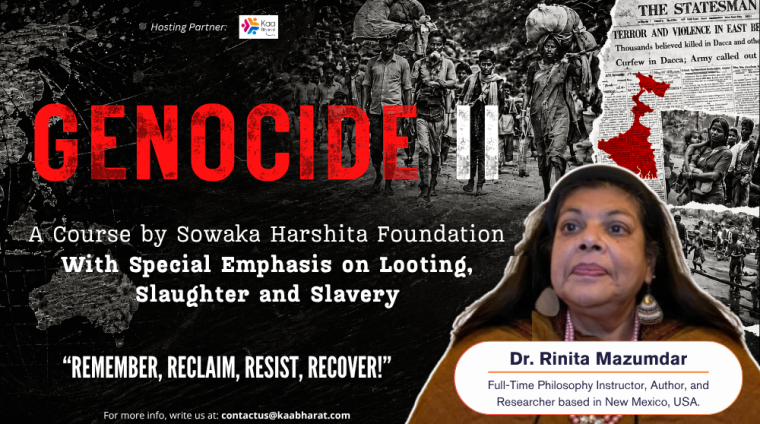
Course Overview:
This 10-session online course, conducted by the Sowaka Harshita Foundation, is Part II of the previous Genocide course and is recommended to be taken in sequence. The course introduces learners to the different definitions of genocide proposed by leading genocide theorists, the United Nations definition on the Prevention of Atrocities and Genocide, and the Indic concept of Jatividhwasho.
Special emphasis is placed on the relationship between Islamic Jihad and Genocide. The course examines Africa and the Indian Subcontinent, Islamic invasion and genocide, and presents a comprehensive study of genocide during the period of Islamic invasions up to Aurangzeb. Dedicated sessions explore Chachnama, the first invasion of Sindh, the seven exodus of Kashmiri Hindus, and the role of Jihad. The course also examines the slavery of Hindu populations, with particular emphasis on Islamic slavery as a component of genocide.
Lectures are conducted in English, with translations provided where necessary. Each session is approximately 75 minutes in duration, followed by an interactive discussion.
Course Structure:
• Duration: 10 Sessions
• Language: English
• Session Length: 75 Minutes + Discussion
• Mode: Online
• Certificate: Included Upon Successful Completion
What You Will Learn:
- Discuss and articulate the important definitions of genocide.
- Distinguish and differentiate the Indic definition from the definition given by Raphael Lemkin and others in the West.
- Articulate the concept of Islamic Jihad and how it created genocide in Kashmir.
- Discuss how Jihad enslaved the non Islamic population in Africa, with special reference to male castration and the Indian sub continent.
Course Layout:
• Upon opening the course, you will find the Course Home Page containing all course modules.
• Navigate to Course Work → Content to access the syllabus, schedule, and weekly modules.
• Select the relevant module to begin that session.
• Each module generally contains:
• Learning objectives, agenda, synopsis, and weekly summaries.
• Articles, PowerPoint presentations, and supporting course materials.
Course Schedule:
The classes are approximately 1 hour and 15 minutes long. Discussions may extend beyond the scheduled duration depending on participation, and some topics may continue into subsequent sessions. Throughout the course, examples from the Great Calcutta Killing, Noakhali Genocide, and the Kashmiri Hindu Genocide will be incorporated where relevant.
| Session | Topic | Description |
|---|---|---|
| 1 | Introductions | What is Genocide? Western concept and the concept of Jatividhwasho. |
| 2 | Islamic Jihad and genocide | Jihad and genocide. |
| 3 | Jihad In Africa | The African slavery. |
| 4 | Islamic invasion | Chachnama |
| 5 | Islamic Jihad and Slavery In the Context of Africa | How does Islam see slavery, slavery in Abbasid Empire. |
| 6 | Islamic Jihad and Slavery In the Context of Africa | Slavery in The Ottoman Empire and The Sokoto Caliphate, the stories of Bashir Agha. |
| 7 | Islamic rule | From Sindh till Aurangzeb and the genocide in Kashmir. |
| 8 | Islamic Jihad and slavery | Islamic Masters Hindu slaves: Slave Trade, Enslavement and Proselytization. |
| 9 | Islamic Jihad and slaves | Hindu slaves: Ghilmans and Eunuchs. |
| 10 | Islamic Jihad and slavery (concluding) | Hindu slaves: Sex Slavery and Conclusion. |
Course Requirements:
• It is recommended that you attend all lectures.
• All lectures will be available on the course website in case you miss a class.
• Each session combines lectures and interactive discussion.
• On the final day, students are required to deliver a short presentation on a topic covered during the course.
• Presentation Duration: 10 minutes followed by discussion.
• In case of difficulty presenting, students should speak with the instructor so that alternative arrangements may be made.
• Students will complete and submit a course evaluation form.
Certification:
Upon successful completion of this course, learners will receive an online certificate issued by the Sowaka Harshita Foundation.
Online Technical Support:
For technical assistance, please contact:
Email: Sowakaharshitafoundation@gmail.com
Technical Support: contact@kaabharat.com
Instructor Bio:
Dr. Rinita Mazumdar is a Full-Time Philosophy Instructor, author, and researcher based in New Mexico, USA. She holds a Ph.D. from Massachusetts and has dedicated her academic career to the study of philosophy, social thought, cultural identity, and genocide studies. As the Director of the Sowaka Harshita Foundation, Dr. Mazumdar is committed to advancing research, education, and public awareness on issues related to genocide, civilizational history, and social justice. Her interdisciplinary scholarship, extensive teaching experience, and ongoing research make her a compelling and insightful instructor for this course.